
What's this?
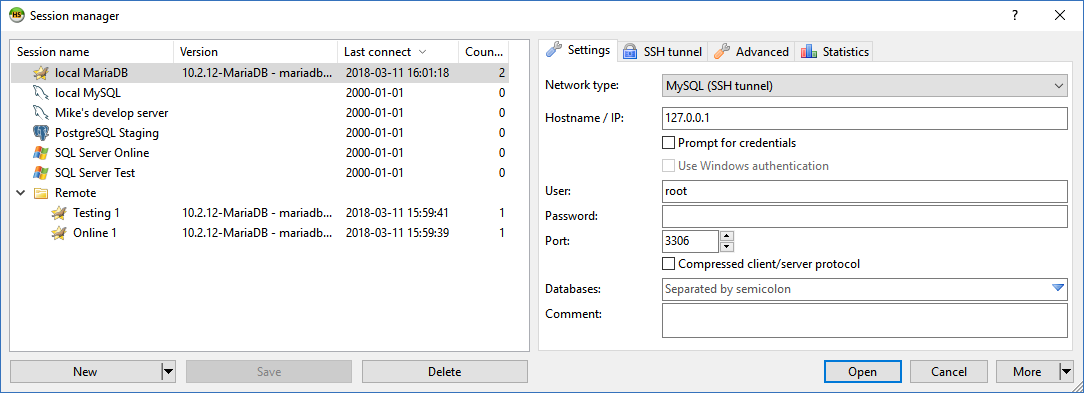
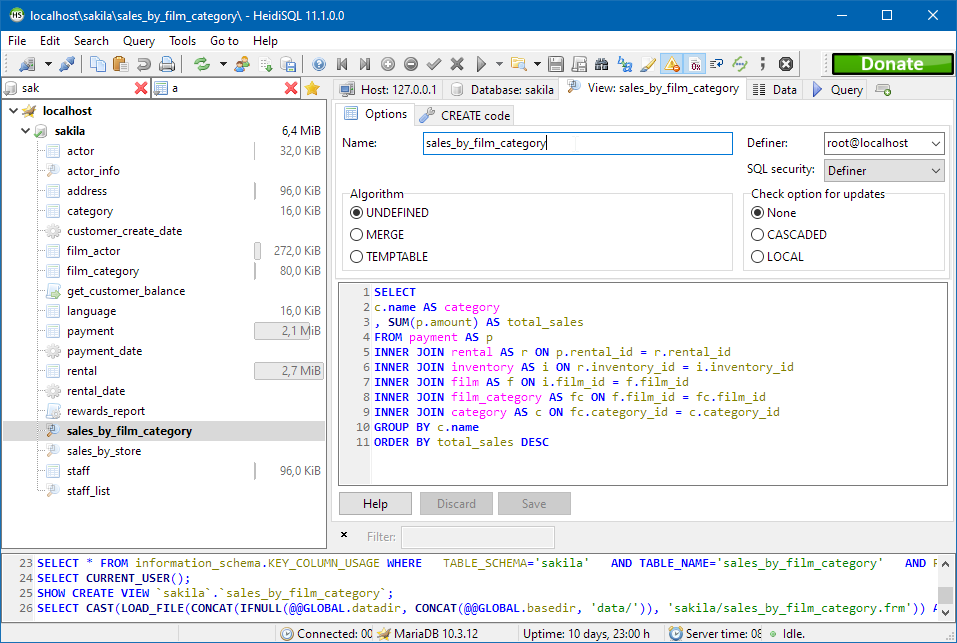
HeidiSQL is free software, and has the aim to be easy to learn. "Heidi" lets you see and edit data and structures from computers running one of the database systems MariaDB, MySQL, Microsoft SQL, PostgreSQL and SQLite. Invented in 2002 by Ansgar, HeidiSQL belongs to the most popular tools for MariaDB and MySQL worldwide.
Download HeidiSQL, read further about features, take part in discussions or see some screenshots.
News 
-
27 Nov Official Instagram profile
Thanks to my daughter HeidiSQL now has an official Instagram profile: https://www.instagram.com/heidisql.official/ Mainly used for screenshots of HeidiSQL, especially of certain dialogs which are r ...
-
05 Nov HeidiSQL 12.6 with two new SQL formatters and static grid row id
Get it from the download page 3rd party updates: Update madExcept exception handler to v5.1.3 Upgrading to Delphi compiler version 11.3 Update VirtualTrees component code to release v7.6.5a Updat ...
-
08 May HeidiSQL 12.5 with Sequal integration
Get it from the download page 3rd party updates: Issue #1784: update OpenSSL libraries used by libpq-15.dll to v3.1.0, taken from http://wiki.overbyte.eu/wiki/index.php/ICS_Download#Download_Open ...
-
26 Feb HeidiSQL 12.4 supporting SSH tunnel on MS SQL, and many bugfixes
Get it from the download page 3rd party updates: Update DDetours sources to latest (2021-01-01) Update vcl-styles-utils sources to latest (2021-01-11) Update gnugettext.pas to rev 148 from http:/ ...
-
05 Dec HeidiSQL 12.3 with fixed auto-updater and support for MySQL on RDS
Get it from the download page 3rd party updates: Update plink binaries to latest v0.78. Closes issue #1430 New stuff: Make clicks on grid column headers configurable, so the user may disable it ...
Features
- Free for everyone, OpenSource
- Connect to multiple servers in one window
- Supported database systems: MariaDB, MySQL, MS SQL, PostgreSQL, SQLite, Interbase and Firebird
- Connect to servers via commandline
- Connect via SSH tunnel, or pass SSL settings
- Create and edit tables, views, stored routines, triggers and scheduled events.
- Generate nice SQL-exports, compress these afterwards, or put them on the clipboard.
- Export from one server/database directly to another server/database
- Manage user-privileges
- Import text-files
- Export table rows as CSV, HTML, XML, SQL, LaTeX, Wiki Markup and PHP Array
- Browse and edit table-data using a comfortable grid
- Bulk edit tables (move to db, change engine, collation etc.)
- Batch-insert ascii or binary files into tables
- Write queries with customizable syntax-highlighting and code-completion
- Pretty reformat disordered SQL
- Monitor and kill client-processes
- Find specific text in all tables of all databases of one server
- Optimize and repair tables in a batch manner
- Launch a parallel mysql.exe command line window using your current connection settings
- And much more
HeidiSQL users with enabled statistics feature work on these servers:
The author: Ansgar Becker

Duinreservaat Noord-Holland.
 Database powered by MariaDB
 HeidiSQL is proudly built with Embarcadero Delphi
